
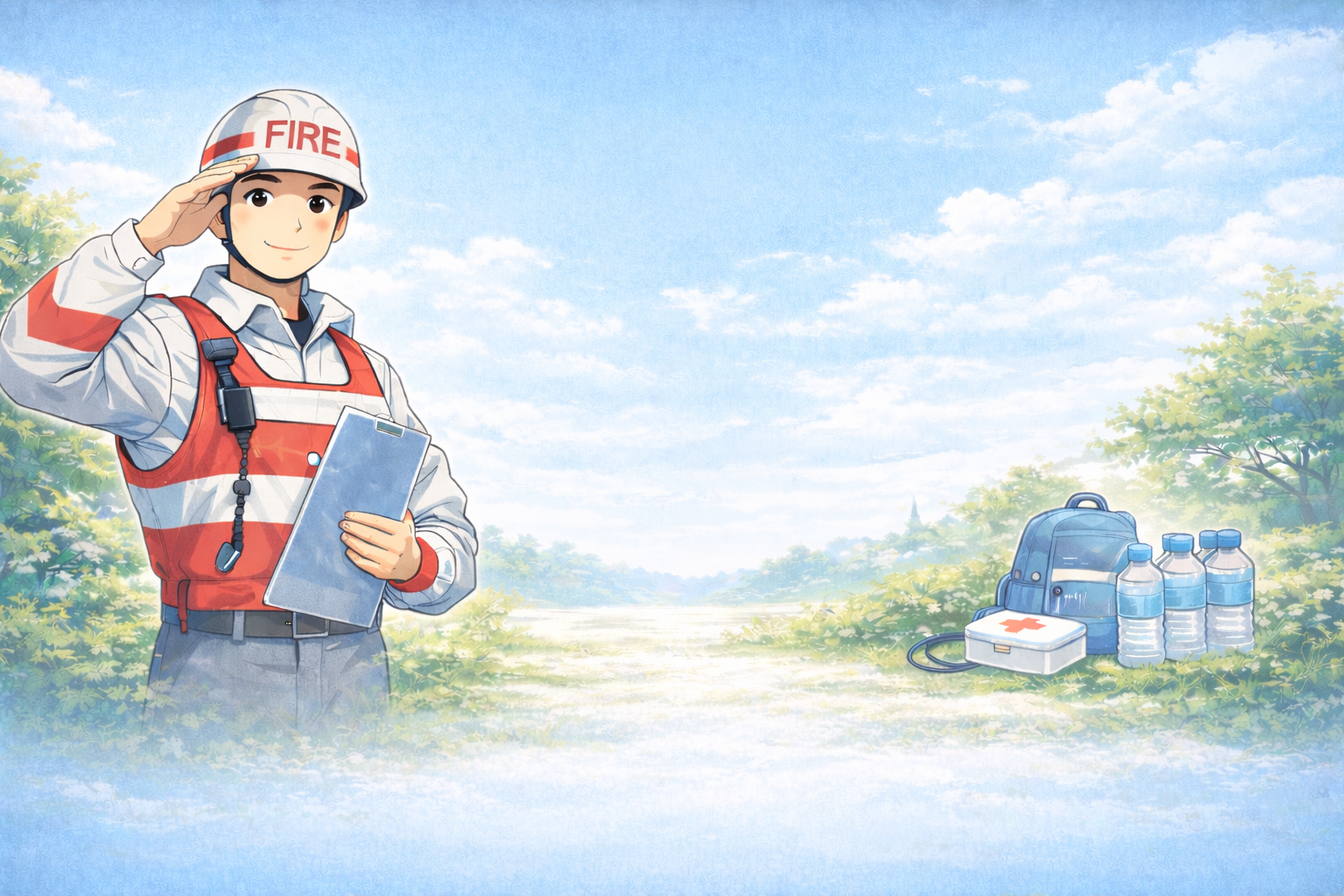
Almost every Filipino household has heard of the go bag. Far fewer have one that is actually packed, reachable in the dark, and light enough to carry down a flooded street while holding a child’s hand. That gap — between knowing and having — is where most emergency preparation quietly fails.
This guide is a practical checklist for building a go bag for a Filipino family. It is organised by priority rather than by category, because when you have thirty seconds to grab a bag, what matters is not how complete it is, but whether the first five items are inside. In disaster response work, the bags that helped most were rarely the biggest ones. They were the ones the family could actually lift and carry for an hour.
- 1. First, understand what a go bag is for
- 2. The weight rule that decides everything else
- 3. Tier 1 — the five things that must be in every bag
- 4. Tier 2 — food, clothing, and staying dry
- 5. Tier 3 — first aid and communication
- 6. Adjusting the bag for who is in your household
- 7. Where the bag lives, and who checks it
- Decision points: what to check before you decide to leave
- What to do today
- Summary
- Sources (public agencies)
1. First, understand what a go bag is for
A go bag is not your household stockpile. The two serve different purposes and mixing them up is the most common mistake:
- Go bag (bug-out bag): what you carry when you leave. Sized for roughly 72 hours away from home, but limited by what you can physically carry.
- Home stockpile: what keeps you alive when you stay. Water drums, canned goods, extra batteries. Heavy is fine — it never moves.
Most Philippine emergencies are of the “stay home” kind — a brownout, a storm passing overhead, roads flooded for a day. But typhoon storm surge, landslides on sloped barangays, a fire in a dense neighbourhood, or a strong earthquake are “leave now” situations. You need both, and the go bag is the one people skip.
If your household stockpile is still thin, start there first: How to Store Emergency Water and Food Safely: A Filipino Family Guide.
2. The weight rule that decides everything else
Before listing contents, set the limit. A useful working figure is 10 percent of body weight for adults and noticeably less for children — and then test it by walking, not by lifting it once in the living room.
Walk around your barangay for fifteen minutes with the packed bag. If you are switching shoulders after five minutes, it is too heavy. During evacuations, people routinely abandon overloaded bags along the road — which means the medicines and documents inside are abandoned too. A smaller bag you keep beats a bigger bag you drop.
Practical note: use a backpack, not a duffel or a plastic bag. You need both hands free — for railings, for children, for balance in moving water.
3. Tier 1 — the five things that must be in every bag
If you pack nothing else this week, pack these:
- Water. A common planning figure is around 3 litres per person per day for drinking and basic use. Carrying three days’ worth for a family is unrealistic, so pack what you can carry — often 1 to 2 litres per person — plus a way to treat more (water purification tablets, or a small filter bottle).
- Medicines. Maintenance medicines for at least one week, in their original labelled packaging. Add a photo of the prescription on your phone and a printed copy in the bag.
- Photocopies of documents. Valid ID, PhilHealth, barangay certificate, birth certificates of children, land or lease papers. Sealed in a zip-lock bag. These are what let you access aid, claim assistance, and prove identity later.
- Flashlight and power. One flashlight per person if possible, plus a fully charged power bank. Head lamps are better than handhelds because they free your hands.
- Cash in small denominations. ATMs and card terminals fail when power and networks go down. Twenty-peso and fifty-peso bills are far more useful than a single one-thousand.
These five weigh little, cost little, and are the ones people most regret leaving behind.
4. Tier 2 — food, clothing, and staying dry
Food
- Ready-to-eat food that needs no cooking and no can opener: biscuits, peanut butter, energy bars, pouch-type tuna or sardines with pull-tab lids
- Instant noodles only if you are certain you will have hot water — otherwise they are dead weight
- Something sweet. In a crowded evacuation centre, familiar food does real work for morale, especially with children
Clothing and rain protection
- One complete change of clothes per person, in a sealed plastic bag so it stays dry
- Closed shoes, not slippers. This is the single most underestimated item. Flood water hides broken glass, nails, open drainage, and sharp debris. Wounds from wading in slippers are one of the most common preventable injuries after floods.
- Raincoat or poncho — more practical than an umbrella when you need both hands
- Malong, blanket, or large towel: doubles as bedding, privacy screen, and warmth
Hygiene
- Alcohol or hand sanitiser, soap, toothbrush
- Toilet paper and wet wipes
- Sanitary napkins — pack more than you think, and pack them regardless of who is carrying the bag
- Garbage bags (large): waterproofing, waste, emergency rain cover, improvised toilet liner
Sanitation deteriorates fast when water supply is interrupted. If your evacuation may last more than a day, read Sanitation During Disasters: Emergency Toilet Options for Filipino Families.
5. Tier 3 — first aid and communication
A basic first aid kit should cover the injuries that actually happen during evacuation: cuts, scrapes, blisters, sprains, and insect bites. That means gauze, adhesive bandages, antiseptic, elastic bandage, gloves, scissors, and paracetamol. Antibiotics and prescription drugs should come from your doctor, not from a checklist.
Wound care matters more than usual after floods, because contaminated water raises the risk of infection. For the sequence to follow before help arrives, see Basic First Aid Every Filipino Household Should Know, and for post-flood illness risks, Medical Preparedness for Disasters.
For communication:
- A battery-powered or hand-crank AM/FM radio. When cell sites are down or congested, radio is often the only channel still delivering official advisories
- A whistle for each family member — carries much further than a shout and uses far less energy
- A written contact card: names, mobile numbers, the address of your designated meeting place, and one contact outside your city. Written, because a dead phone takes your contact list with it
6. Adjusting the bag for who is in your household
Infants: formula, bottled water for mixing, diapers, wipes, a carrier or wrap (a stroller is useless in flood or debris), and any maintenance medicine.
Young children: a small comfort item, snacks, a spare set of clothes, and an ID band or card with their name and a parent’s number.
Older adults: maintenance medicines with a written list of dosages, spare eyeglasses, hearing aid batteries, and a copy of recent medical records. Consider that their walking pace sets the family’s evacuation timing.
Pets: food for several days, a leash or carrier, and a photo of the pet with a family member for identification if separated.
7. Where the bag lives, and who checks it
A go bag stored at the back of a cabinet under the stairs is not a go bag. Place it:
- Near your main exit, or beside your bed if earthquakes are your primary concern
- Above expected flood level if you are in a low-lying area — this is the detail most often missed. Many families lose their emergency supplies to the same flood they were preparing for
- Somewhere every family member, including children, can point to without being told
Check the bag twice a year. Tie it to something you already remember — for instance, at the start and end of the rainy season. Replace expiring food and medicine, update children’s clothing sizes, recharge the power bank, and confirm the documents are still current.
Decision points: what to check before you decide to leave
The bag matters less than the decision to use it. Ask these in order:
- Is the official advisory telling you to evacuate? PAGASA warnings and your LGU or barangay’s pre-emptive evacuation orders come first. Do not wait for water to be visible in your street.
- Is your route still passable? Moving water above knee height for an adult is already dangerous, and it is far more dangerous for children and older adults. If in doubt, do not cross — go up instead.
- Is everyone accounted for? Confirm people before packing. The bag is already packed; that is the whole point.
- Is it daylight? If a warning is in effect and conditions are worsening, moving early and in daylight is almost always safer than waiting.
- Is staying actually safer? For a strong upper-floor concrete structure away from slopes and surge zones, vertical evacuation may be the better option. For light-material houses, near rivers, coasts, or steep slopes, leaving early is usually the safer call.
What to do today
- Pack the Tier 1 five into any backpack you already own. Twenty minutes. Do not wait until you can buy a proper kit.
- Photocopy your documents and seal them in a zip-lock. This costs almost nothing and is the item people most regret losing.
- Agree on one meeting place outside the house and one contact person outside your city, and write it on a card for each family member’s bag, wallet, or school bag.
Summary
A go bag works when it is light enough to carry, close enough to reach, and known to everyone in the house. Completeness is a distant fourth. Start with water, medicines, documents, light, and cash — those five cover most of what determines how the first 72 hours go.
Then walk with it. The walk is what turns a list into preparation. Everything else on this page is easier to fix than discovering, in the middle of a rising flood, that the bag is too heavy to bring.
Sources (public agencies)
- National Disaster Risk Reduction and Management Council (NDRRMC) — https://ndrrmc.gov.ph/
- PAGASA (DOST) — https://www.pagasa.dost.gov.ph/
- Philippine Red Cross — https://redcross.org.ph/
This article is general preparedness information. Always follow the advisories of PAGASA, NDRRMC, and your local government unit, and consult a licensed medical professional for health concerns.
Ready America 3-Day Survival Box (1-Person)
A ready-made 72-hour kit is useful when a family has not yet built its own go-bag. Use it as a starting point, then add local documents, medication, cash, chargers, and water for your household size.
Before buying, compare local availability, shipping, household size, and official guidance.
As an Amazon Associate I earn from qualifying purchases.
Comments