
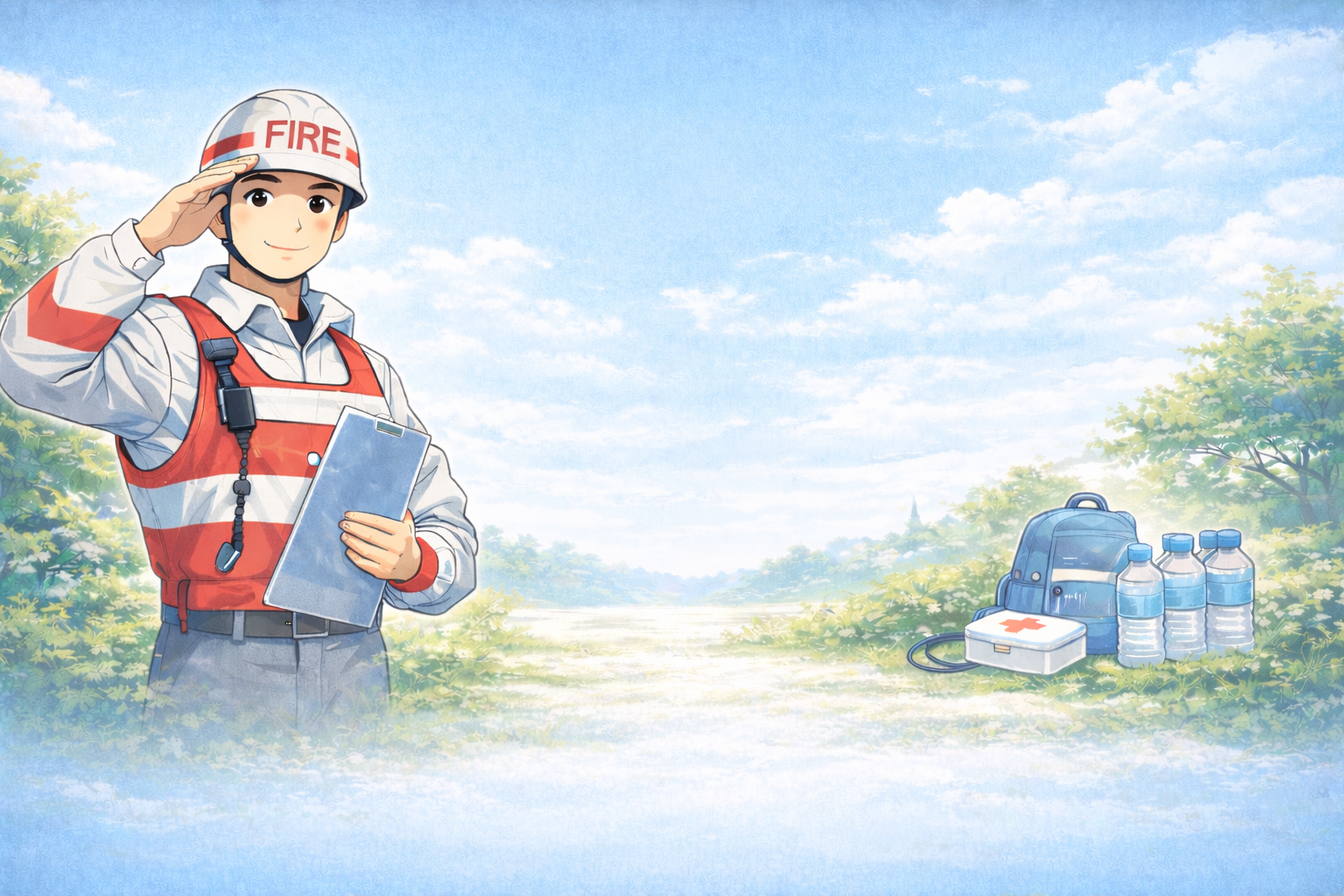
The Philippines sits on the Pacific Ring of Fire, and that single geographic fact shapes almost everything about how Filipino households should think about earthquake safety. Unlike a typhoon, which PAGASA can track for days before landfall, an earthquake gives you no warning at all. The shaking either starts or it does not — and whatever you do in the first ten seconds is limited to what your body already knows how to do.
That is the honest starting point of this guide. Earthquake preparedness is not about having a clever plan you will remember under stress. It is about narrowing your choices down to a few simple actions, practising them until they are automatic, and removing the hazards in your home that would hurt you before you ever get the chance to react.
In disaster response work, one pattern repeats across almost every earthquake: most injuries are not caused by buildings collapsing. They are caused by falling objects, broken glass, and people moving during the shaking. That distinction matters, because it means a large share of earthquake injuries are preventable with preparation that costs very little.
- Understanding the Hazard: Why Philippine Earthquakes Are Different
- The First Ten Seconds: Duck, Cover, and Hold
- What Actually Injures People: Securing Your Home
- After the Shaking Stops: The First Hour
- Preparing for the Days After, Not Just the Minutes
- Making It Automatic: Drills That Actually Work
- Key Judgment Points
- What to Do Today
- Summary
- Official Sources
Understanding the Hazard: Why Philippine Earthquakes Are Different
PHIVOLCS monitors several active fault systems across the archipelago. The West Valley Fault, which runs through parts of Metro Manila and nearby provinces, is the one most often discussed in public preparedness campaigns, but it is far from the only one. Active faults and trenches run through Luzon, the Visayas, and Mindanao, which means there is no region of the country that can reasonably describe itself as earthquake-free.
Three characteristics make Philippine earthquake risk distinctive:
Dense, mixed-quality construction. Many urban neighbourhoods combine engineered concrete structures with informally built homes, often on narrow streets. This affects both the shaking risk and the rescue access afterwards. Emergency vehicles simply cannot reach some areas quickly.
Compound hazards. Earthquakes in the Philippines frequently trigger secondary events — landslides in mountainous provinces, liquefaction in reclaimed coastal areas, and tsunami risk along certain coastlines. Preparing only for the shaking itself leaves gaps.
Coastal exposure. For communities near the coast, a strong earthquake is itself the tsunami warning. If the shaking is strong enough that you cannot stand, or lasts unusually long, coastal residents should move to higher ground without waiting for an official advisory. Official warnings are valuable, but for a nearby-source tsunami there may not be time for one to reach you.
PHIVOLCS also uses the PEIS (PHIVOLCS Earthquake Intensity Scale), which describes what people actually felt and what damage occurred, rather than magnitude alone. This is worth knowing because two people can experience the same earthquake very differently depending on distance, soil type, and building. Magnitude is one number for the whole event; intensity is what happened where you were standing.
The First Ten Seconds: Duck, Cover, and Hold
The Philippine standard is Duck, Cover, and Hold, and the reason it has survived decades of scrutiny is simple: it is the action most likely to protect you from the thing most likely to hurt you.
Duck. Drop to your hands and knees immediately. This lowers your centre of gravity so the shaking cannot throw you, and it lets you move if you need to.
Cover. Get under a sturdy table or desk and protect your head and neck. If there is no table nearby, move against an interior wall away from windows, and cover your head with your arms. Protecting the head and neck is the priority — these are the injuries that turn a survivable situation into a serious one.
Hold. Keep one hand on the leg of the table and move with it. Furniture slides during strong shaking. A table that has slid two metres away is no longer protecting you.
Several things people commonly believe are worth correcting:
- Do not run outside during the shaking. The area immediately outside a building is where falling glass, signage, and concrete facing land. Most people who are injured trying to exit are hurt in the doorway or on the street, not inside.
- Doorways are not safer. This advice comes from older building types and does not apply to modern reinforced structures. A doorway offers no protection from falling objects and puts you in the path of a swinging door.
- Do not use elevators. If you are in one when shaking starts, press every floor button and exit at the first one that opens.
- If you are in bed, stay there and cover your head with a pillow — unless there is a heavy light fixture or shelf directly overhead, in which case move away from it.
- If you are driving, pull over away from overpasses, bridges, and power lines, and stay in the vehicle until the shaking stops.
What Actually Injures People: Securing Your Home
This is the part of earthquake preparedness with the highest return, and the part most households skip. Walking through your home and asking one question in each room — “what would fall on someone here?” — will find most of the risk in about fifteen minutes.
Priorities, in order:
Anything tall and heavy near where people sleep. Aparadors, bookshelves, and cabinets in bedrooms are the highest-priority items. A wardrobe falling onto a bed is one of the most serious household earthquake hazards, and it is also one of the easiest to fix with an L-bracket into a wall stud or concrete anchor.
Objects stored high. Suitcases, boxes, and appliances stored on top of cabinets become projectiles. Move heavy items to low shelves and keep the top of tall furniture clear.
Glass. Framed pictures and mirrors above beds and sofas should be moved or secured. Glass cabinet doors can be covered with safety film.
Gas and appliances. Know where your LPG tank shutoff is and make sure every adult in the household can find it in the dark. After strong shaking, if you smell gas, do not switch anything electrical on or off — including light switches — open windows and get everyone out.
Shoes under the bed. This sounds minor and is not. After an earthquake, floors are covered in broken glass and debris. A pair of closed shoes and a working flashlight kept within reach of the bed prevents a large share of post-earthquake injuries.
After the Shaking Stops: The First Hour
When the shaking stops, the situation is not over. Aftershocks follow major earthquakes, sometimes for weeks, and some are strong enough to bring down structures already weakened by the mainshock.
A workable sequence for the first hour:
- Check yourself, then others nearby. Adrenaline masks injuries. Look before you assume you are fine.
- Put on shoes. Before walking anywhere.
- Check for fire and gas. Fire after an earthquake is a serious secondary hazard, and it spreads while emergency services are overwhelmed.
- Evacuate if the building is damaged — visible cracks in columns, doors that will not close, tilting floors. Use stairs, never elevators.
- Move away from the building to an open area, away from walls, power lines, and glass facades.
- Send messages, do not call. Text messages get through congested networks far more reliably than voice calls, and they use much less battery.
- If you are near the coast and the shaking was strong or long, move to higher ground immediately without waiting for confirmation.
- Listen to official information — a battery or hand-crank radio is the most reliable channel when networks and power fail.
On the communication point: in disaster response, one of the most common problems is not people being trapped, but people making dangerous journeys because they could not reach their family. Agreeing in advance on what happens when phones fail removes most of that risk. The practical structure for this is covered in our family communication plan guide, and the offline version — SMS, written notes, meeting rules — is covered in what to do when the internet is down.
Preparing for the Days After, Not Just the Minutes
A significant earthquake affects water, power, and transport across a wide area at once. That is different from a typhoon, where the damage is often more predictable in location and duration.
Plan for a minimum of 72 hours of self-sufficiency:
- Water. Roughly three litres per person per day for drinking, plus more for washing. Water lines are often damaged and may take longer to restore than power.
- Food that needs no cooking. Canned goods, biscuits, and instant items. If you are relying on LPG, remember you may not be able to use it safely until you are sure there is no leak.
- Medicines. A minimum of one week of any maintenance medication, plus a written list of what each family member takes and the dosage. Pharmacies may be closed or inaccessible.
- Power. Charged power banks, extra batteries, and a flashlight per person. Practical detail on managing a prolonged outage is in our power outage preparedness guide.
- Cash in small denominations. Card terminals and ATMs depend on power and network.
- Copies of documents in a waterproof bag.
If you have not assembled a go bag yet, work from a priority list rather than trying to pack everything at once — our go bag checklist orders items by what matters first.
One point that is easy to miss: stockpiles fail quietly. Water expires, batteries drain, medicines pass their date, and children outgrow the clothes packed for them. A stockpile you assembled two years ago and never checked may not be the stockpile you think you have.
Making It Automatic: Drills That Actually Work
The National Simultaneous Earthquake Drill run through NDRRMC is a genuinely useful national exercise, but a drill you run at home matters more, because your home is where you are most likely to be when it happens.
A useful household drill takes ten minutes:
- Everyone practises Duck, Cover, and Hold in the room they are actually in — not gathered in the living room. The point is to learn where the cover is in each room.
- Walk the evacuation route to your open-area assembly point.
- Have each person locate their shoes and flashlight in the dark.
- Have children practise saying their full name, their parents’ names, and a contact number out loud.
Do this twice a year. Tie it to something you already remember — the start of the school year, or a birthday — so it does not depend on anyone deciding to organise it.
Key Judgment Points
If you retain only a few things from this guide, make it these:
- During shaking: get low, protect your head, do not run outside. The exit is more dangerous than the interior in most buildings.
- Falling objects cause most injuries. Securing tall furniture near beds is the single highest-value action available to most households.
- Near the coast, strong or long shaking is itself the tsunami warning. Move to high ground without waiting for an announcement.
- Send messages, do not call. And agree in advance that “no contact” means “assume safe and stay put,” not “come find me.”
- Aftershocks are part of the event. A damaged building that survived the mainshock may not survive the next one.
These are general principles, not rules that override the situation in front of you. If local officials, your barangay, or the BFP give instructions during an actual event, follow those instructions first.
What to Do Today
Three things, none of which require a budget:
Walk through your home and identify the top three falling hazards. Start with the bedrooms. Anything tall, heavy, and near where someone sleeps goes first.
Put shoes and a flashlight within reach of every bed. Tonight. This takes five minutes and prevents injuries that are otherwise almost guaranteed.
Agree on your family meeting point and your out-of-area contact, then write both on a card that each family member carries. Not in a phone — on paper. Phones run out of battery.
Summary
Earthquakes cannot be forecast, and that is exactly why preparation works differently for them than for typhoons. There is no window in which to get ready once it starts. Everything useful has to be in place beforehand: the furniture already anchored, the shoes already under the bed, the meeting point already agreed, the drill already practised enough that your body does the right thing before your mind catches up.
Almost none of it is expensive. A few brackets, a flashlight, a written card, and twenty minutes of family conversation covers most of what matters. The gap between prepared and unprepared Filipino households is rarely about money — it is about whether anyone did those small things on an ordinary day, long before they were needed.
Official Sources
- PHIVOLCS (Philippine Institute of Volcanology and Seismology) — earthquake monitoring, active fault maps, and the PHIVOLCS Earthquake Intensity Scale
- NDRRMC (National Disaster Risk Reduction and Management Council) — national drills, advisories, and preparedness guidance
- Philippine Red Cross — first aid training and community disaster preparedness
This article was prepared by a former firefighter and certified disaster preparedness instructor as general guidance. It does not replace instructions issued by local authorities, your barangay, or emergency services during an actual event.
Ready America 3-Day Survival Box (1-Person)
A ready-made 72-hour kit is useful when a family has not yet built its own go-bag. Use it as a starting point, then add local documents, medication, cash, chargers, and water for your household size.
Before buying, compare local availability, shipping, household size, and official guidance.
As an Amazon Associate I earn from qualifying purchases.
Comments